
From platforms to code: The future
defence industry
The military–industrial complex of the future might look different from that of the past. Technological developments, from information technology in general to recent achievements in AI, are bringing new expectations and new players into the military-industrial field. The traditional defence industry has long integrated software into military systems; now there are software companies integrating military components into software-based products. However, the requirements for defence equipment are different from those for software products. Will the promises of the new actors hold, and will the old actors stand aside? How will states, which constitute the market and maintain strong ties to the traditional industry, act? The shaping of the future defence industry will affect many, not only companies, but also nations and future
defence capabilities.
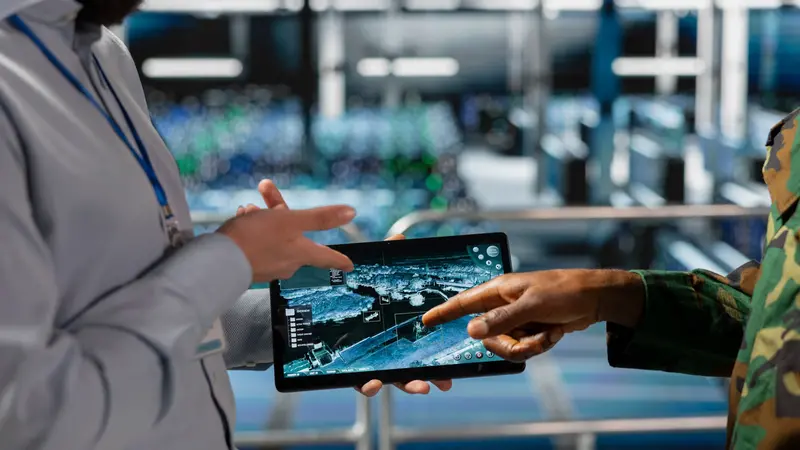
The defence industry does not operate in a conventional open market economy. Rather, it functions within a highly regulated environment shaped by export control regimes, national security legislation, state procurement policies, and multilateral non-proliferation frameworks. Market access, technology transfer, ownership structures, and even supply chains are subject to political oversight to a degree unmatched in most other sectors. The customer base is narrow and concentrated, with only 25 states accounting for more than 90 per cent of global defence expenditure. Governments are not merely clients but also regulators, sponsors of research and development, and, in many cases, strategic partners.
The United States, responsible for roughly 40 per cent of global defence spending and home to the world’s largest defence industrial base, illustrates these dynamics clearly. Over the past three decades, the US defence sector has undergone significant consolidation. The number of prime contractors has fallen from 51 in the early 1990s to five major companies today, which together account for approximately one-third of the US Department of Defense contract obligations. This consolidation has reshaped competitive dynamics, supply chain structures, and the state–industry relationship, raising ongoing debates about resilience, innovation, and national autonomy within the defence industrial base.
Government defence contracting operates under structural constraints. The use of taxpayer funds requires parliamentary oversight and executive branch scrutiny, generating administrative burdens. While these mechanisms ensure accountability, they also increase transaction costs and can slow capability development. Although the US defence industrial base includes up to 100,000 firms, prime
contracting is concentrated among five dominant companies—Lockheed Martin, RTX Corporation, Northrop Grumman, Boeing, and General Dynamics. At this level, the market resembles an oligopoly rather than a competitive buyer’s market.
This structure has reinforced a traditional model centred on large organisations, long-term contracts, state-funded R&D, and hardware-intensive platforms such as missiles, aircraft, and armoured systems. While such platforms will remain relevant, future military advantage will increasingly depend on software, autonomy, and system integration
Software powers future defence technology
Future weapons systems will be increasingly software-defined, with operational effectiveness driven as much by code as by hardware. The trajectory is clear: greater autonomy, rising system complexity, and a growing share of functionality implemented in software rather than in physical components. As complexity increases, systems integration becomes a strategic capability in its own right. Ensuring interoperability and coherent performance across multiple subsystems will require sustained investment in architecture design, integration expertise, verification, and life-cycle software management.
The development of complex, software-intensive systems requires a fundamentally different industrial model than that used for traditional military hardware. Historically, defence primes have specialised in integrating hardware subsystems, with software adapted to platform-specific requirements. Future military capabilities, however, will depend increasingly on artificial intelligence, autonomy, and data-centric architectures, domains driven by cutting-edge research in computer science rather than by platform engineering alone.
During the Cold War, the defence sector was a primary engine of technological innovation. In the post–Cold War consolidation, driven by business logic, reduced defence spending, and pressure for cost reductions, the number of major US prime contractors declined from 51 to five. Following this, innovation leadership shifted toward the commercial sector, particularly in areas such as the internet, personal computing, and consumer electronics. As a result, many critical enabling technologies now originate outside the traditional defence industrial base.
In response, the Defense Innovation Unit (DIU), established by the US Department of Defense in 2015, was designed to accelerate access to commercial innovation, particularly in AI and autonomous systems. By lowering entry barriers for non-traditional vendors and emphasising rapid prototyping and iterative
procurement, DIU represents an institutional adaptation to a software-driven innovation environment.
The creation of the Defense Innovation Unit (DIU) signalled an attempt by the US Department of Defense to tap commercial innovation while mitigating the constraints of its traditional acquisition system. At the same time, a new generation of non-traditional defence firms has emerged from major technology ecosystems, including Google, Facebook, and Amazon.
The newcomers
Firms such as Anduril Industries and Helsing illustrate this transformation. Initially focused on AI-enabled surveillance, data fusion, and decision-support software, they have leveraged private capital to expand into hardware and weapons systems. Anduril has pursued acquisitions in autonomous vehicles and propulsion, while Helsing has partnered with established manufacturers such as Rheinmetall and Saab to enter the combat drone market.
The surge of interest in artificial intelligence across defence establishments, accelerated by Russia’s full-scale invasion of Ukraine, has reshaped capability planning across the North Atlantic Treaty rganization. All NATO members have increased defence spending and signalled strong demand for AI-enabled systems, driven by the perception that operational advantage will hinge on data exploitation, autonomy, and algorithmic decision-support. This has created both a technology push and a strategic pull: a widespread concern that failure to adopt AI at scale could translate into battlefield disadvantage.
The result is a significant influx of capital into defence technology ventures. Firms such as Anduril Industries and Helsing exemplify a new class of companies attracting substantial public and private investment by promising rapid delivery of AI-enabled capabilities. However, the accelerated pace of innovation and deployment is generating pressure on existing procurement processes, certification
regimes, and regulatory frameworks, which are often criticised as slow and riskaverse. How to enable rapid experimentation and fielding of AI-driven systems while preserving accountability, interoperability, safety standards, and compliance with domestic and international law remains an open question.
Procurement: Complex and capability-critical
Defence procurement procedures are not solely designed to ensure market competition, financial accountability, and traceable decision-making. Their complexity also reflects the intrinsic demands placed on military capability development. Equipment must be safe, reliable, and demonstrably fit for purpose. While assessing suitability may be straightforward for simple tools, it becomes considerably
more complex for advanced, networked systems operating in contested and uncertain environments.
Military platforms, weapons, and command-and-control systems do not function in isolation. They must integrate into highly complex organisational structures characterised by dense intra- and inter-system dependencies. Materiel must perform under diverse operational conditions, align with existing logistics architectures, remain maintainable over long service lives, and ensure interoperability with both legacy and future systems. Training burdens must also remain manageable.
These cumulative requirements generate extensive and often rigid specification frameworks. Despite sustained reform efforts aimed at simplification and streamlining, defining and validating requirements for complex military systems remains a structurally demanding task. This underscores a central tension: accelerating innovation must not come at the expense of operational coherence, safety, and long-term sustainability within the broader defence ecosystem.
Predictability and safety are intrinsic requirements in the development and deployment of weapons and other hazardous military systems. Unexpected system failures, such as an aircraft crash caused by software malfunction, pose risks not only to personnel but also to mission success. Systems whose failure may result in catastrophic consequences are classified as safety-critical, and their design and
certification impose stringent technical and regulatory demands.
Integrating software into safety-critical functions significantly raises the bar for reliability, verification, and validation. Unlike general-purpose software applications, where a system restart may be inconvenient but tolerable, software in flight-control systems or weapons platforms must meet exceptionally high assurance standards. Such development practices are well established in aerospace and traditional defence industries but differ markedly from mainstream commercial software engineering.
Cultural fusion or collision
The difference between the old and the new reflects a broader cultural gap. Emerging defence technology firms often originate from software environments that prioritise agility, rapid iteration, and continuous feature deployment. In contrast, safety-critical military systems require stability, formal verification, and tightly controlled update cycles. Bridging this cultural and methodological divide will
take time and deliberate institutional effort.
Adding to this challenge, segments of the Western aerospace and traditional defence industrial base face demographic pressures, including an ageing workforce and shortages of specialised engineers after decades of industrial restructuring and offshoring. Higher education in the West is in many respects driven by competitive publishing in new research frontiers. Funding pressures and the need for rapid publication make it risky to embark on research paths in classical fields still needed by the traditional defence and aerospace industry. Although the title “rocket scientist” still holds its value, fewer graduate students study areas such as control theory, aerodynamics, flight mechanics, and other subjects that are still needed in industry.
Software is already a central part of the defence industry, but software and AI algorithms alone do not create kinetic effects. Missiles can be designed to fly higher, faster, and with more adaptive explosive effects, advancements that require expertise from many fields. Bridging the cultures and knowledge of the modern, software-focused industry and the traditional, more hardware-focused defence industry could have transformative effects, but a bridge requires two supports.
A strategic vision
The Western defence industry is built on a heritage shaped in a period of high defence spending and educational systems with a long-term perspective, when “rocket scientist” was a coveted title. New technologies do not always replace older ones; they are sometimes complementary to existing systems, which still need to be maintained and further developed. Software-driven companies now entering the defence sector must engage with legacy technologies, not only through acquisitions, but also through intellectual integration to enable continued development. Educational systems need to maintain relevant programmes and attract students to them. Achieving this requires a strategic vision at the policy level. In a market-driven society, this can be a challenge.
There are other countries, mainly in Asia, where the state pursues a clear strategic vision. Over the past three decades, China has built a comprehensive industrial base spanning consumer manufacturing, advanced aerospace, space systems, and large-scale production of autonomous platforms. Its defence spending has grown continuously since the early 2000s and now ranks second globally, behind the
United States. Following parallel investments in higher education and the post-Cultural Revolution reconstruction of China’s university system, its universities now produce large numbers of engineers and doctoral graduates, strengthening the country’s technological capacity. The 15th five-year plan, released in March 2026, underscores the importance of self-reliance not only in production capabilities but also in AI and software development. The aim is for China to eventually become independent of US big-tech companies’ software. The shift can already be seen in a number of Chinese-developed large language models, of which DeepSeek is the most well-known.
The strategic question is whether innovation leadership in defence will remain anchored in US-based commercial software technology ecosystems or shift toward competitors able to combine engineering scale, sustained state support, and comparatively fewer regulatory constraints. The answer, in the form of action by policymakers, will shape not only military capability development, but also the future balance between open-market innovation models and state-directed in state-directed industrial strategies in strategic technologies.
This article is written by researcher Martin Hagström as part of the report Strategic Outlook 11: Wide Awake in a World of Disorder. The report examines how geopolitical tensions, economic uncertainty, and rapid technological change are reshaping the international system and challenging established patterns of cooperation. It explores key security, economic, societal, military, and technological developments emerging in an era of strategic rivalry and systemic competition.