
A new nuclear order
The world is stepping into a new nuclear era. What will replace the old order is highly uncertain. Current arms control agreements and nuclear norms are eroding while great power rivalry is overtaking the global agenda. Understanding the developments and dynamics of this change will be pivotal not only to navigate it but also to make strategic decisions in a more hostile and dangerous world.
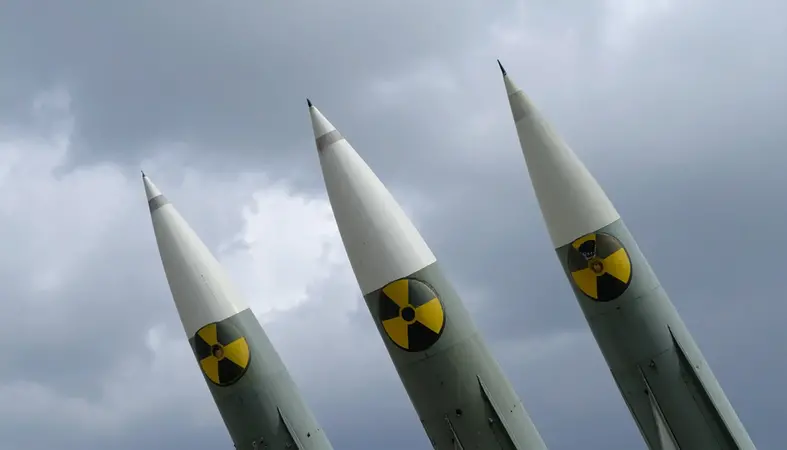
Photo: Shutterstock
Great power rivalry has returned to the forefront of international politics. The rise of China, Russia’s resurgence, and the US’s efforts to maintain its post–Cold War global dominance are transforming the current world order.
With New START set to expire this year, the last bilateral strategic arms control
instrument defining the size of US and Russian nuclear warheads and delivery vehicles will come to an end. However, the end of New START is just the latest in a series of arms control setbacks: the Russian parliament, the Duma, revoked its ratification of the Comprehensive Test Ban Treaty (CTBT) in 2023; only five years earlier, citing repeated Russian violations of the treaty, in particular the development and fielding of the 9M727 (or SSC-8) ground-launched cruise missile, the first Trump administration withdrew from the Intermediate-Range Nuclear Forces Treaty (INF). While China is a signatory to the CTBT, the US accuses China of conducting critical nuclear tests in violation of the treaty. China is a signatory to the Non-Proliferation Treaty (NPT), has pledged not to export nuclear weapons or assist third parties in acquiring them, and has committed itself to the total reduction of nuclear arsenals. That said, China has so far refused to engage in any meaningful arms control agreements and has instead built up its nuclear forces on an unprecedented scale. Add to this the proliferation of India, Pakistan, and North Korea, and the architecture of arms control instruments and nuclear norms that once defined the post–Cold War nuclear era has changed beyond recognition.
A three-player game
Perhaps the most defining feature, and indeed the biggest driver, of the new global nuclear order is that it is now a three-player game made up of the US, Russia, and China. This is creating a different strategic situation, in stark contrast to the Cold War period when the nuclear landscape was defined foremost by the bipolar competition between the US and the Soviet Union. Today, these three major players increasingly view nuclear capabilities as a vital part of adapting their military forces and national security strategies to a new era of geopolitical competition.
For decades, Russia has modernised its nuclear forces, replacing old capabilities with newer, more advanced systems. In one sense, since the end of the Cold War Russia has held a fundamental belief that it must maintain a strong and capable nuclear arsenal, not the least to compensate for its conventional weakness visà-vis the US and NATO. Nuclear weapons are perhaps Russia’s only remaining source of leverage, especially as its economy, exports, and industrial output falter in comparison with those of the US and China. The pivotal role that nuclear weapons play for Russia has become crystal clear after its full-scale invasion of Ukraine, during which it has repeatedly used nuclear coercion and threats to discourage deeper US and NATO involvement, while also raising the possibility of deploying nuclear weapons to Belarus. Russia’s war against Ukraine has also created a new problem for Russia: with most of its conventional forces tied up in Ukraine, any serious challenge to its power may prompt a rapid resort to nuclear escalation, not because of strategy, but because of necessity.
China, which only a decade ago was a minor nuclear power, is in the midst of a substantial transformation of its nuclear arsenal and, some believe, its nuclear strategy. It now possesses a fully operational nuclear triad (land, air, and sea-based nuclear strategic deterrent) similar to that of the US and Russia. Its nuclear forces are more diverse, mobile, and accurate, and the readiness level of the PLA Rocket Force has increased. China’s nuclear stockpile has tripled in the last decade, now exceeding 600 warheads and projected to reach 1,000 by 2030. The quantitative and qualitative changes have raised concerns that China is changing its traditional defensive strategy based on assured retaliation to open up options for a more distinct regional nuclear posture, most likely to coerce and deter regional powers
and the US from intervening in a potential military conflict over Taiwan.
The US, partly as a response to China and Russia, is also putting renewed focus on its nuclear arsenal. As early as during the Obama administration, the US had initiated a USD 1.7 trillion programme to upgrade its land, air, and sea-based nuclear capabilities, but at the same time sought to reduce the total number in its stockpile and not develop any new weapon types. However, the Biden and Trump administrations have been moving ahead with modernising the nuclear forces, for instance developing more diverse delivery systems, such as the nuclear-tipped Sea-Launched Cruise Missile (SLCM-N) and adding new initiatives such as the Golden Dome missile-defence system as the most extravagant example. The US approach to nuclear deterrence is strategically and economically demanding as it seeks what it calls “damage limitation,” which essentially means that the US Armed Forces, including its nuclear forces, seeks to be so robust that even an opponent with equal nuclear force size will stand a low chance of gaining a strategic advantage.
And then there is the rest
The global nuclear landscape is made even more complicated as it now also involves many more nuclear-armed states than during the Cold War. This includes not only the traditional nuclear powers of the UK and France but also the nuclear proliferators of India, Pakistan, and North Korea. These states have long held relatively constant nuclear arsenals and postures or developed rather limited nuclear capabilities. But with the crumbling of the legal and institutional framework for arms control and non-proliferation, growing strategic competition between the US, Russia, and China, these states are also taking note and starting to review the capabilities and strategies of their own nuclear forces.
Partly due to Russian nuclear sabre-rattling in the Ukraine war and partly due to concerns over US extended deterrence commitments in Europe, France and the UK are reviewing their nuclear arsenals and doctrines. France is reviewing the number of deployed warheads, has added a nuclear-capable air wing, and is developing a new hypersonic nuclear-tipped cruise missile. This capability development was accompanied by a historic speech by France’s President Emanuel Macron in March 2026, in which he opened the door to closer collaboration with key European allies and to their involvement in France’s nuclear mission. The UK, whose arsenal is closely tied to that of the US, has just announced plans
to rejoin NATO’s DCA mission (Dual-Capable Aircraft that can carry the US nuclear gravity bomb B61-12). Moreover, in 2025 France and the UK signed the Northwood Agreement, a landmark step to further coordinate their nuclear deterrence strategies.
ust as Europe is adjusting to a new nuclear reality, India is gradually expanding its arsenal and also developing new delivery systems, much in response to China’s nuclear buildup, underpinned by an unresolved border dispute and broader strategic competition over regional dominance in South Asia. India, however, is also concerned about Pakistan, its local arch-rival, which it seeks to deter. Pakistan,
which is conventionally inferior to India, must therefore rely on having a credible nuclear deterrent. Moreover, North Korea now has a small but increasingly capable nuclear arsenal, and efforts by the international community to push for North Korean disarmament seem all but dead. The state of Iran’s nuclear weapons programme remains uncertain after US missile strikes on nuclear facilities in 2025, but concerns are far from gone in the Middle East where nuclear-armed Israel continues to view Iran as its main regional threat. With the US’s latest war in the Middle East aimed at Iran and what is left of its attempt to develop nuclear weapons, the world has taken yet another step into uncharted territory.
The question of acquiring a national nuclear-weapon capability has reawakened in some states that are concerned about the reliability of US security guarantees. For instance, in South Korea there is renewed debate about developing its own nuclear weapons to deter potential North Korean aggression. The same applies to Poland, which has asked to host NATO nuclear weapons and where public debate over a national programme has begun.
The shape of things to come
Historically, the risk of nuclear war has been mitigated by a combination of arms control instruments on the one hand, which temper destructive power and curb arms races, and nuclear deterrence on the other, which aims to ensure that any state using nuclear weapons will lose more than it could ever hope to gain. With arms control instruments gone or under pressure, deterrence, particularly nuclear deterrence, is increasingly becoming the principal strategic tool for mitigating the risk of nuclear exchange. However, deterrence, while often effective, relies on increasing the risk for the opponent, thus also augmenting the overall risk. Far fewer nuclear warheads are deployed today than at the height of the Cold War, but the trend towards more nuclear weapons and fewer constrained rules and norms regulating the global nuclear order heralds more strategically challenging times.
Nuclear weapons are the most powerful weapons humankind has invented, but the underlying technology stems from the 1940s. The impact of technological developments such as artificial intelligence (AI), quantum computing, cyber capabilities, and advanced satellite systems on the role of nuclear weapons in deterrence is not yet clear. On the one hand, innovations can make old systems more precise and add efficiency. However, advances in conventional capabilities, for instance long-range deep strike, can also seriously challenge deployed nuclear arsenals. Improved space and cyber capabilities can make both nuclear coercion and deterrence more difficult, but also possibly enable them. Command and control systems with integrated AI can introduce new risks and challenges as well as improve decision times. Add sophisticated missile defences to the mix and this new variety of technological advances creates a strategic environment that will be challenging to gauge for challengers and defenders alike. This type of uncertainty may at times temper the appetite of a challenger, as the outcomes of an attack against a conventional, but technologically sophisticated, adversary may be difficult to foresee.
For Europe and countries such as Australia, Japan, and South Korea, new technological advances in weaponry potentially provide an alternative, as they may still wish to resist nuclear proliferation without compromising their own security. For all that new technology does, it does not come cheap. Investment in defence capabilities is already increasing in both Europe and Asia, but the pace and variety will pressure countries that currently are struggling financially to keep an acceptable growth rate.
Despite all the new strategic developments, from nuclear deterrence and arms control to nuclear proliferation and advanced technologies, the constant challenge all must face is the cost of defence. The state that can outspend an adversary has always enjoyed a strategic advantage, and states that invest strategically may be best placed to dictate the arms control instruments of the future.
This article is written by researchers Karl Sörenson and Christopher Weidacher Hsiung, as part of the report Strategic Outlook 11: Wide Awake in a World of Disorder. The report examines how geopolitical tensions, economic uncertainty, and rapid technological change are reshaping the international system and challenging established patterns of cooperation. It explores key security, economic, societal, military, and technological developments emerging in an era of strategic rivalry and systemic competition.