
Europe’s defence industry at a crossroads
Europe’s defence industry is highly advanced, but it consists largely of relatively small companies shaped by national preferences. Whether rising global defence spending will result in greater integration between these companies remains to be seen.
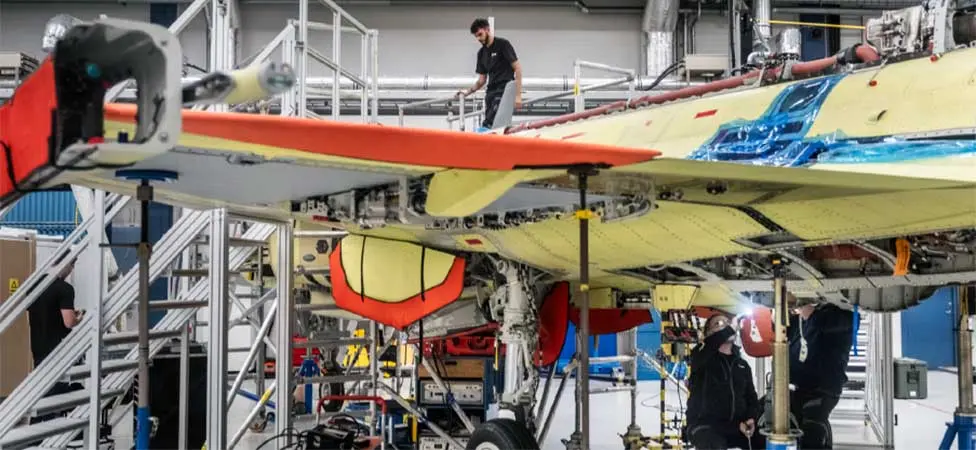
Gripen E under assembly in Linköping. Photo: Magnus Hjalmarson Neideman SVD / TT.
Commissioned by the Ministry of Defence, researchers at the Swedish Defence Research Agency (FOI) have prepared the report Defence Industrial Outlook 2025. It provides an overview of the global defence industry and examines how Europe’s defence sector has become more integrated over the past two decades.
The US clearly dominates, but China is catching up
The global overview highlights the following:
The US is in a league of its own. Its defence companies are the largest, the most innovative, and the most technologically advanced.
- China’s defence industry still lags behind that of the US, but has become significantly more modern and innovative in just a few years.
- Russia has a broad industrial base and remains strong in several niche areas. Its industries, however, are generally less advanced than those in the West, while sanctions and lack of funding mean that the gap with Western countries is growing.
- Europe has many highly advanced firms capable of producing almost everything. Globally, however, these companies are relatively small. They are also deeply shaped by national preferences. There is a reluctance to engage in large-scale integration, which leads to duplication of effort.
Of the world’s defence companies, 41 of the 100 largest are based in the US.
“The US has long been the dominant player and, even though China’s defence industry is growing rapidly, the US is likely to remain in first place. However, China has significantly narrowed the capability gap with the US. It has become highly proficient at producing advanced weapon systems,” says Anton Hammarstedt, analyst and one of the report’s authors.
Europe: deeper integration or growing dependence on non-European suppliers?
After Russia’s full-scale attack on Ukraine in 2022, Europe has embarked on a massive rearmament, following a long period of disarmament.
“Debate about the fragmentation of the European defence industry has been a recurrent theme over the past decade, and the current rearmament has brought this issue even more sharply into focus. Compared with the US and China, Europe’s defence industry is often described as highly fragmented, which is something we wanted to examine more closely in this report,” says Anton Hammarstedt.
The large-scale rearmament and the current security situation have also meant that companies in, for example, the US, South Korea, and Turkey are securing an increasingly large share of the spending generated by Europe’s rearmament. So why does Europe’s defence industry so often operate in national silos?
“Historical choices and national priorities, as well as specific national requirements, have a strong influence on the types of equipment European countries purchase. So far, we have not seen that various European cooperation formats and initiatives such as OCCAR, EDA, PESCO, and the EDF have led to large-scale integration,” says Calle Håkansson, researcher and co-author of the report.
Even so, the researchers do see a measurable increase in industrial integration in Europe.
“Soviet-built systems are finally disappearing from Europe, and the share of defence cooperation based on common platforms is increasing,” says Per Olsson, researcher and co-author.
The researchers conclude by warning that there are also risks associated with extensive consolidation among European defence firms.
“It may also lead to weaker competition and greater vulnerability,” says Anton Hammarstedt.