
The Philippines is an increasingly important actor
The Philippines is gaining in geopolitical significance as rivalry between China and the US intensifies in the South China Sea. Sweden’s government has also begun to take a greater interest in the Southeast Asian island nation.
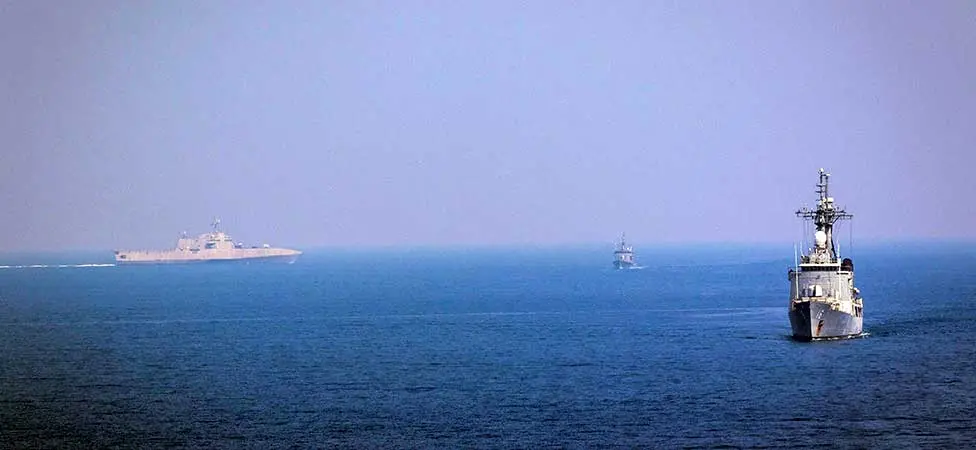
USS Savannah (LCS 28) together with BRP Ramon Alcaraz (PS-16) och BRP Apolinario Mabini (PS-36) during the military exercise Balikatan in April 2025. Photo: Chief Petty Officer Leonard Adams, Ampibious Squadron 11, Defense Visual Distribution Service, U.S. Defense Media Activity.
The Philippines’ modern history is sometimes summed up as “three hundred years in a Spanish convent and fifty years in Hollywood,” a phrase that points to its colonial legacy under Spain and the United States.
“It is true that this is a fundamentally religious, largely Catholic society, while at the same time it has become strongly Americanised in recent decades,” says Olivier Milland, an analyst at the Swedish Defence Research Agency (FOI).
But the reality is more complex. In a new FOI report, Milland describes the Philippines’ security policy and strategic outlook. The island nation has become an increasingly important actor because of its geographical location and close ties to the United States. At the same time, it is investing in a substantial defence build-up.
“The Philippines’ security situation is very interesting. This is partly due to the country’s relationship with China, and partly due to its role in the broader power struggle in the region,” says Olivier Milland.
Defence policy in transition
The Philippines’ ground forces have been a key priority for many years because of internal conflicts with communist and Muslim insurgent groups. As tensions in the South China Sea have grown, the country is gradually modernising and restructuring its armed forces, focusing instead on its navy and air force as it seeks to strengthen its control of the maritime domain.
“Earlier attempts to modernise the armed forces have failed due to limited resources and external challenges. The current process, now in its third phase, is more successful, although challenges remain. A major issue is capacity: there is neither the bandwidth nor the time to execute planned spending,” says Olivier Milland, adding: “Another challenge is that China’s modernisation is moving much faster. Even if the Philippine armed forces are modernising in absolute terms, they are doing so slowly compared with China.”
The weakest link in the US alliance system
The Philippines is often viewed as the weakest link in the US’s regional security system. The country’s military capability is limited, particularly at sea, while its geographic location makes it strategically exposed.
“The historically strong relationship with the United States has deepened in recent years, and US defence personnel now have access to nine Philippine bases. That is a clear signal to China,” says Olivier Milland.
In recent years, China has intensified its presence in the area by stepping up patrols and expanding infrastructure on atolls and reefs within waters deemed to belong to the Philippines.
“China is acting more aggressively and is increasingly trying to control waters claimed by both Beijing and Manila. China is also seeking to destabilise the Philippines domestically, including by cultivating political support through investments,” says Olivier Milland.
Domestic political challenges remain
Internal divisions still mark the Philippines. Historically, both communist and Islamist armed groups have posed security threats, but these are now weakened.
“A peace process is under way with Muslim groups in the southern Philippines, where local elections have recently been held and greater self-government is being introduced. However, the country remains very much a clan-based society, with powerful local leaders and widespread corruption,” says Milland.
Political power has alternated between the Duterte and Marcos clans, whose power bases lie in the south and north of the Philippines respectively. Ferdinand Marcos ruled as dictator until 1986. In 2022, his son, Ferdinand Marcos Jr, was elected president, succeeding Rodrigo Duterte, whose time in office saw 30,000 people killed in his so-called war on drugs.
“There are many leaders seeking to enrich themselves, and corruption must be regarded as systemic. Party politics are weak and built on dynasties that operate at several levels, with family members and close associates in positions throughout the state apparatus.”
Growing Swedish interest
Like several other European countries, Sweden has shown increasing interest in the Philippines. Deeper cooperation could contribute to greater security and create opportunities for Swedish defence exports. The Philippines is interested, among other things, in the JAS Gripen.
“Sweden is a NATO country, and whatever strengthens the United States ultimately strengthens us. We can contribute by bolstering the alliance indirectly, for example through defence exports and knowledge exchange,” says Olivier Milland.