
A balance between adaptation and resistance
In a new memo, researchers at FOI review the potential consequences of the Greenland crisis for transatlantic, European, and global security. The US is expected to continue to take a tough line towards allies and to reduce its engagement in Europe. NATO allies must decide where to strike the balance between adaptation and resistance in relation to the US.
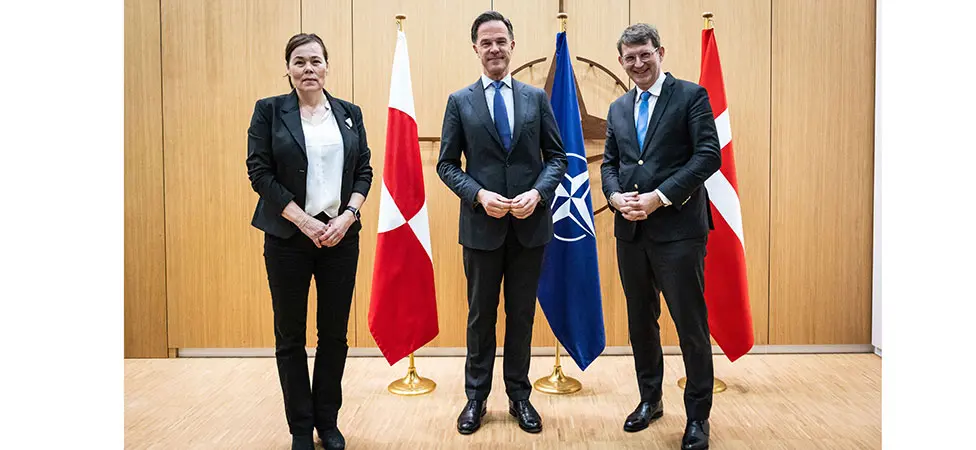
Vivian Motzfeldt, the Minister for Foreign Affairs and Research in the Greenland Self-Government; Mark Rutte, NATO’s Secretary General; and Troels Lund Poulsen, Denmark’s Minister of Defence: three actors who acted differently during the Greenland crisis. Photo: NATO.
According to FOI’s researchers, the Greenland issue is hardly resolved, and they assess that it is likely to remain an element in the US’s relations with Europe, Russia, and China in the future. Is the US behaviour primarily linked to President Trump, or does it reflect a continuation of the US’s reorientation away from Europe?
“NATO still exists, but the crisis may also prove to be the beginning of the end, at least for NATO in its current form,” says Alina Engström, a researcher at FOI.
“It is likely that Greenland is only the first of several crises in which the US puts heavy pressure on NATO allies,” says Olof Kronvall, an analyst at FOI.
During the Greenland crisis, some actors emphasised the importance of adapting to the US. Examples include NATO’s Secretary General, Mark Rutte; the Baltic states, and Poland. The Nordic countries and the rest of the EU combined adaptation with resistance, for example through clear statements in support of Denmark and by agreeing to take part in the Arctic Endurance military exercise in Greenland. The US declined to participate in the exercise, and Trump threatened the countries that planned to participate with tariff increases.
According to the researchers, both adaptation to and resistance against the US entail risks for Europe. Denmark’s long-standing reputation as a model US ally meant little once the threats to take over Greenland began to emerge. Firm resistance to the US, in the form of sharp criticism, tough trade policy, and security-policy measures directed against the US, can be dangerous for Europe, because Europe remains dependent on the US militarily, economically, and technologically.
Gains for Russia and China
The Greenland crisis also affects Russia and China. They look favourably on the US’s questioning of the rules-based world order. Russia is also glad that the crisis shifts attention away from Russia’s war against Ukraine. It also sees US demands regarding Greenland as legitimising its annexation of Crimea. China sees an opening to strengthen economic ties with Europe at the US’s expense.
However, if the Greenland crisis were, in the longer term, to lead to a stronger Europe, less dependent on the US and China, Russia would view this unfavourably. Neither China nor Russia would welcome increased US and/or European presence in the Arctic, as it would limit their influence there.