
EU on the defensive in the technology race
Intensifying rivalry among the world’s major powers has sharpened strategic competition between states, not least between the United States and China. Much of this competition revolves around technology. Researchers at FOI have examined how the EU is responding to developments in 3D printing.
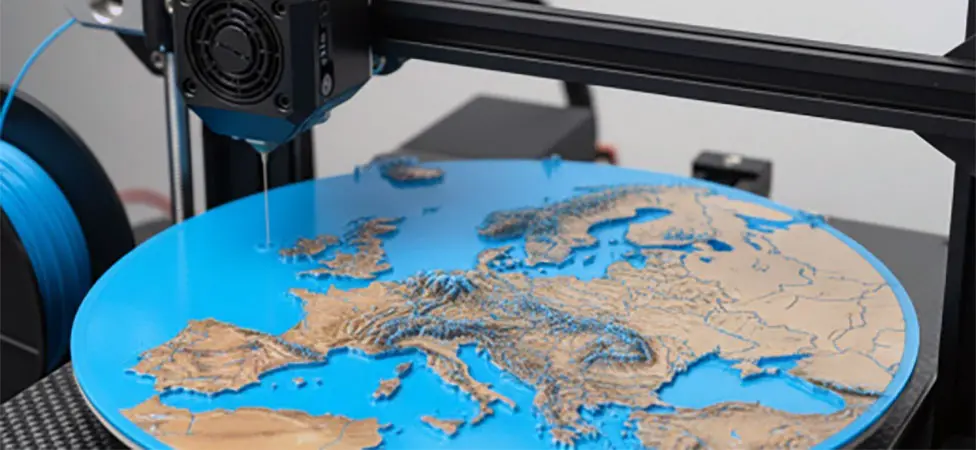
The EU regards additive manufacturing as a critical technology for its economic security and aims to remain among the leading players in the field. The image is AI generated in Shutterstock.
Strategic competition spans everything from diplomacy to economic pressure and military methods. These developments have led the EU to place greater emphasis on economic security and strategic autonomy.
“We are emerging from a historical context that was strongly focused on rules, cooperation, and building a better world together. In many ways, that was desirable, and it was how Europe wanted to approach other countries. But unfortunately, the world has since moved in a different direction, with competition increasingly shaping the international order,” says Anders Schröder, an analyst at FOI’s Defence Analysis Division.
A critical technology for security
States use a wide range of tools to compete with one another.
“War is the ultimate instrument. But there are many ways to influence others. Control over new technology is one such source of power, albeit a softer one. Who controls value chains and has the expertise to develop the latest technology? Who sets the rules of the game? This has increasingly become a means of power,” says Anders Schröder.
Commissioned by the Swedish Ministry of Defence, Anders Schröder and his co-authors, Anna Wagman Kåring and Ingemar Pettersson, have examined how the EU is dealing with issues related to additive manufacturing, that is, 3D printing. Their findings are presented in the report EU additive manufacturing policies amid strategic competition.
“The study explores what this technology race looks like in relation to a specific technology and asks: what the EU is doing in response?”
According to Anders Schröder, the EU regards additive manufacturing as a critical technology for its economic security and aims to remain among the leading players in the field.
3D printing also has a security dimension. It can be used in supply chains to repair combat vehicles more quickly, and it is an important tool in strategically important industries that manufacture satellites and fighter aircraft.
“This is partly a question of potential military utility, but it is also about European competitiveness and our ability to safeguard and strengthen European industry in different ways. Additive manufacturing can make us less dependent on different value chains,” says Anders Schröder.
Better at protecting than promoting
At the same time, additive manufacturing remains overshadowed by larger technologies, such as AI, which is the subject of extensive political attention and major investment.
The researchers have sought to identify what the EU is doing to promote and protect its position in additive manufacturing. They started from the EU’s economic security strategy, identified relevant policies, and then grouped the EU’s measures into three approaches: promote, protect, and partner.
“What we find is that the EU is fairly good at protecting European industry. But we see less activity when it comes to promotional measures and partnering.”
In concrete terms, the EU has focused on protecting the industry that already exists, for example through different forms of research funding and through tighter rules on who may benefit from it.
“The rules governing which companies may be acquired by foreign actors have been tightened, and the EU is also trying to influence how standards are set, which can benefit European industry if the resulting standard suits it.”
At the same time, the EU lacks a strategy for additive manufacturing. Countries such as the United States and the United Kingdom have such strategies aimed at their armed forces, and the EU has one for AI.
Political resistance to reform
According to Anders Schröder, the EU’s apparently defensive approach to additive manufacturing is consistent with the criticism Mario Draghi raised in his 2024 report on European economic competitiveness.
“It is very much in line with discussions in broader EU circles at the moment: the EU is quite good at these more defensive measures, but has generally struggled to strengthen its competitiveness.”
Anders Schröder believes that it comes down to politics.
“These are issues that are rarely decided by the European Commission alone. They require agreement with the member states, and there may be a range of reasons why those states are unwilling to implement reforms that might benefit the EU as a whole but would also require them to relinquish certain powers. That is a constant challenge for the European project.”