
Shifting Powers: The Global South in a
Changing World Order
It long seemed that economic liberalisation, globalisation, and democratisation were making the distinction between the North and the South increasingly irrelevant. However, recent years have witnessed the return of this dichotomy as the Global South has emerged as a geopolitical factor in world politics due to a combination of political, economic, ideological, and institutional factors. While there is a tendency to focus on great power rivalry as a driving force in world politics, dynamics within the Global South are just as likely to shape the future of the world order, calling for a more finegrained understanding of its political and economic dynamics. The challenge for the Global South is whether growing economic weight and diplomatic coordination will
translate into durable rule-shaping power under conditions of geopolitical rivalry, financial volatility, and persistent structural asymmetries.
The Return of the Global South
The Global South, a collective shorthand for developing countries in Africa, Asia, the Middle East, and Latin America, is back. Not that it had ever really gone away. But several dramatic events, such as the COVID-19 pandemic, Russia’s full-scale invasion of Ukraine, and the Israel-Hamas war, as well as global negotiations about climate change funding and international tax cooperation (under the UN Framework Convention on International Tax Cooperation), have exposed the persistence of frictions between countries in the North and in the South. For instance, although several countries from the Global South voted to condemn Russia’s actions in the United Nations General Assembly, many abstained from voting. Furthermore, few of the countries from the Global South have imposed sanctions on Russia.
The emergence of the Global South as a geopolitical factor on the global stage came as a surprise to many observers. For a long time, it had seemed that the division of the world into a wealthy and industrialised Global North and a poor and developing Global South had lost both its descriptive value and its political salience. Globalisation and economic liberalisation paved the way for economic growth in many countries in the South, leading to increasing economic diversity and a gradual shift in the world economy from the “West” (North) to “the rest” (South). The notion that the division between the South and the North was no longer relevant was reinforced by the ascendancy of the international liberal order, particularly in its post-Cold War form, when the US as the sole superpower sought to extend the reach of liberal norms, markets, and institutions globally, and the rallying behind values of multilateralism, cooperation and democracy.
Moreover, the increasing economic and political diversity within the Global South seemed to indicate that the interests of countries in the Global South would diverge to such a degree that the distinction between North and South would become increasingly meaningless and lose its explanatory value. However, despite these transformations, the Global South, as a unifying category, has persisted and reappeared on the global scene in the last couple of years. There are several political, economic, ideological, and institutional reasons for this persistence.
Economic factors
While the economic divide between North and South is no longer as stark, poor and developing countries are still concentrated in the South. Although the poorer countries of the South might not share economic interests with the (economic) powerhouses of the Global South (such as India and Brazil),
some interests are still shared, for instance on questions of human development and climate change.
Political factors
Despite some openings and reforms, the global distribution of power has failed to reflect geoeconomic transformations, such as political representation in key international institutions (for example, the UN Security Council and the International Monetary Fund, IMF) and has not kept pace with the economic rise of Global South states. Furthermore, many countries in the Global South share a historical experience of colonialism and marginalisation that influences their understanding of global political and economic inequalities.
Ideological factors
Current discourses and narratives around the Global South, such as South–South cooperation and an insistence on strategic autonomy in the face of heightened great power rivalry, borrow some of their ideological underpinnings from earlier periods of mobilisation and positioning. These trace back
to the Afro-Asian Bandung Conference in 1955 and the Non-Aligned Movement (NAM) established in 1961. This is not to overplay the ideological motivation of countries in the Global South, whose actions are motivated just as much by strategic interests as other countries’ are, but to note that historical connections still matter even if the context has changed.
Institutional factors
The institutions and broad coalitions that were created during the wave of “third world” mobilisation of the 1960s and 1970s, such as the NAM and the G77, survived the vagaries of world politics and continued to function even after the attention of the world turned away from the Global South. While
the high point of Global South mobilization, exemplified by the push for a New International Economic Order (NIEO), remains in the past, these organisations have survived as important platforms for alliance-building and diplomatic coordination. Economic diversification within the South has not dissolved these ties. Moreover, newer institutions and coalitions have emerged: the African Union (AU), BRICS, and the Asian Infrastructure Investment Bank (AIIB) represent a more recent layer of South-centred institution-building.
BRICS and shifting geoeconomic power
The reemergence of the Global South also needs to be understood against the backdrop of changes in global economic power. Twenty years ago, global power concentrated in the mature economies of North America, Europe, and Japan, whose overwhelming leads in output, trade, technological innovation, and military spending reflected the legacy of the post-World War II order. Two decades later, the balance appears more diffuse. As of 2025, the World Bank states that “low and middle income” economies, roughly encompassing the Global South, account for approximately 35 per cent of the world’s nominal GDP, including China’s share at circa 17 per cent. These economies account for about 85 per cent of the world’s population and are an increasing driver of economic growth. According to Boston Consulting Group, the Global South’s combined GDP, excluding China, is projected to grow at an average annual rate of 4.2 per cent through 2029, compared with 1.9 per cent for advanced economies.
The United States remains the single largest economic and military actor, but its relative dominance has narrowed as China is now the world’s second largest economy (by nominal GDP), the world’s largest exporter of goods, an emerging technological superpower, with an increasingly modern and capable military force. India’s rapid growth and rising innovation base, alongside the resource-driven
resurgence of countries such as Saudi Arabia and Brazil, point to a broader redistribution of economic weight toward Asia and parts of the Global South. Taken together, these developments trace a transition from a transatlantic-centred system to a more multipolar landscape in which economic scale, technological capability, and geoeconomic ambition spread across a wider constellation of states.
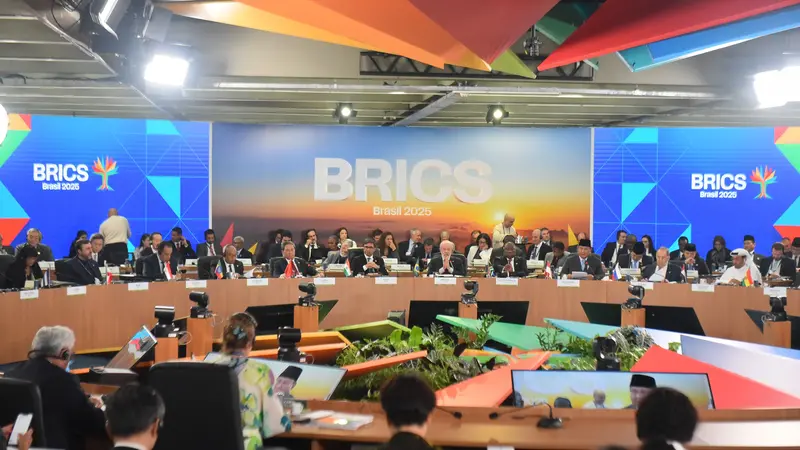
The evolution and expansion of BRICS exemplify this renegotiation. Originally founded in 2009 as a forum for Brazil, Russia, India, China, and South Africa, and significantly expanded in 2023, the grouping has gradually moved beyond symbolic coordination toward institutional consolidation and a more explicit ambition to influence global governance. China is by far the largest economy within BRICS, though India’s growing weight may shift internal dynamics over time. Following its 2023 expansion, BRICS’ founding members have been joined by Egypt, Ethiopia, Indonesia, Iran, and the UAE. Scholars and analysts characterise BRICS+ not simply as a balancing coalition but as a site of norm production, advancing alternative principles on sovereignty, development finance, and conditionality.
The coordinated call by BRICS finance ministers for reform of the IMF’s quota system reflects this structural ambition: to recalibrate representation in Bretton Woods institutions in line with contemporary economic weight and to challenge entrenched leadership conventions. These proposals echo long-standing demands from the Intergovernmental Group of Twenty-Four and other Global South platforms. At the same time, recent scholarship cautions against overestimating cohesion. Persistent asymmetries within South–South arrangements, including trade concentration, uneven technological capacity, and divergent national interests, continue to constrain collective agency. Contemporary commentary on recent BRICS summits similarly notes the tension between expanded numerical weight
and uneven strategic coherence.
Debates over de-dollarization and alternative financial infrastructure have become central to the evolving BRICS agenda. Proposals for cross-border payment systems, local-currency settlement mechanisms, and central-bank digital currency linkages aim to reduce reliance on the US dollar and the SWIFT network. Central banks across emerging markets have simultaneously increased gold reserves and diversified reserve holdings as part of broader strategies to mitigate volatility associated with dollar dominance. In practice, a growing share of trade between major emerging economies is already being settled in national currencies, while new settlement instruments are being developed to reduce conversion risk.
These shifts reflect what recent international political economy literature describes as the geoeconomics of fragmentation and the logic of weaponised interdependence, the recognition that control over financial and technological networks can be used coercively, prompting diversification strategies among vulnerable states. The US response underscores the geopolitical stakes, as demonstrated by US threats of punitive tariffs tied to BRICS alignment.
The Global South and great power competition
While the re-emergence of the Global South is tightly intertwined with the rebalancing of economic power, its geopolitical importance has also grown in light of the increase in great power rivalry and the current transformation of the world order.
Prominent academics and observers, including political scientist John Ikenberry and Finland’s President Alexander Stubb, have identified the Global South as one of three competing poles of power, alongside the Global West (the US, Europe, and their close allies) and the Global East (China, Russia). In their reading, the Global West and the Global East are competing for influence in the Global South because both need support from countries in the Global South to impose their respective visions of world order. China and Russia, from different positions and from different histories, have certainly gone to great lengths to increase their influence in the Global South. Both promote ideological visions of a new world order that challenges the dominance of the West, while tightening concrete economic, political, and technological ties with countries in the Global South. So far, the majority of countries in the Global South, true to the tradition of nonalignment and insistence on strategic autonomy, have responded by maintaining relationships with multiple poles of power (the US, EU, Russia, and China), although this at times requires a balancing act.
The recent world turmoil, amplified by the transactional, unpredictable, and often contradictory initiatives from the current US Trump administration, has challenged established norms, upended traditional friendships and weakened the cohesion of the West. In this landscape of uncertainty, states in the Global North find themselves dazed and confused, unaccustomed to the strong-arm approach
employed in, for example, the Greenland crisis. But this is not new to most countries in the Global South. Politicians and observers across the Global South are deeply familiar with this style of politics.
In short, the weakening of the liberal international order has not necessarily appeared as unpredictable to observers in the Global South as it has to observers in the Global North. While vulnerable to global economic instability, countries in the Global South are accustomed to political volatility. In this new reality, it will be increasingly important for small- and medium-sized states in the Global South and the Global North to shift perspectives and look for “like-minded” partners beyond the North-South divide to offset the loss of stability and predictability.
Looking ahead, multiple geopolitical flashpoints coincide with profound economic realignments, providing a test for both the strategic autonomy of developing states and the broader contest over the shape of the global order. For nations of the Global South, the challenge is not merely to absorb external shocks, from renewed great-power rivalry to tightening trade regimes, but to consolidate agency in an international system that is fragmenting. Will emerging and developing states be able to convert their large, growing, and increasingly skilled population (demographic scale), market growth, and diplomatic coordination into durable influence over global rules and institutions? If they can manage to do so, key actors in the Global South are set to play a major role in shaping the future world order, rather than merely absorbing the outcomes of geopolitical rivalry between Washington and Beijing.
This article is written by researchers Gabriella Körling and Carl Marklund, as part of the report Strategic Outlook 11: Wide Awake in a World of Disorder. The report examines how geopolitical tensions, economic uncertainty, and rapid technological change are reshaping the international system and challenging established patterns of cooperation. It explores key security, economic, societal, military, and technological developments emerging in an era of strategic rivalry and systemic competition.