
Central Asia advances its regional agenda
Central Asia’s position is growing in importance as the world becomes increasingly multipolar. Kazakhstan and Uzbekistan rely on pragmatic cooperation and diplomacy to navigate the differing agendas of the great powers. An FOI report examines how the two countries are increasingly taking their future into their own hands.
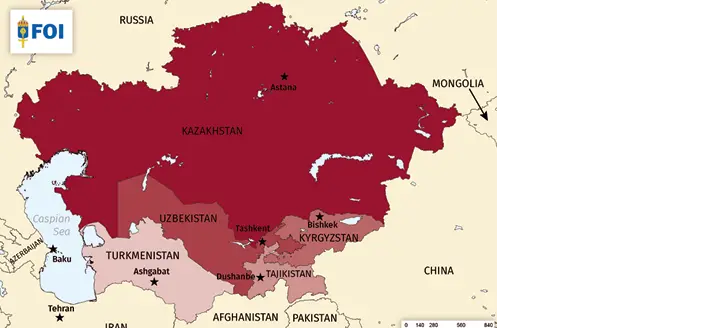
Central Asia has long been a meeting place for empires and civilisations, linked through trade and other forms of contact. Map made by FOI.
Viewed from Sweden, Central Asia remains something of a blank spot on the map, according to Johan Engvall, Deputy Research Director in FOI’s Department of Eurasian Security Policy. Engvall has researched the region for more than 20 years. His report Forming a New Central Asia: How Kazakhstan and Uzbekistan Build Regional Order under Multipolar Pressure adopts the countries’ own perspective.
“The region is often portrayed as an object: an area in which various great powers operate. I reverse that perspective and examine developments as the region’s own leaders see them.”
A region shaped by trade routes
Kazakhstan and Uzbekistan are part of Central Asia, a region bordered by Russia to the north and west, China to the east, and Iran and Afghanistan to the south.
“Central Asia has long been a meeting place for empires and civilisations, linked through trade and other forms of contact. That legacy has profoundly shaped its countries and remains evident in their diplomacy today,” says Johan Engvall.
For centuries, the region was shaped by the east–west trade routes and contacts that linked Asia and Europe. North–south routes between Russia and India were also important. Under Soviet rule, however, the Central Asian countries became increasingly isolated.
“Back then, all roads led to Moscow, while other links were severed. The countries are now working to overcome the isolation they inherited when they gained independence in the 1990s.”
Drawing on local media, Western media, and presidential speeches, Johan Engvall has developed an understanding of the dynamics in Kazakhstan and Uzbekistan. He focuses on these two countries because they represent aspiring middle powers that are distinguished from the smaller, less influential neighbouring states of Turkmenistan, Kyrgyzstan, and Tajikistan.
“Kazakhstan is the wealthiest country in Central Asia and has vast natural resources. Uzbekistan has the region’s largest population, lies at its geographical heart, and borders all the other Central Asian states as well as Afghanistan.”
Relations between Kazakhstan and Uzbekistan were poor in the years following their independence from the Soviet Union, but have improved rapidly over the past decade. Following Russia’s full-scale invasion of Ukraine in 2022, the two countries signed a Treaty on Allied Relations and have since, among other things, settled their border disputes.
Delicate relations with Russia
In the report, Johan Engvall examines the two countries’ relations with other key states and international actors. Russia remains an important partner for both, not only in trade but also in energy and infrastructure.
“Kazakhstan has closer structural ties to Russia. The two countries share the world’s longest continuous land border, and Kazakhstan has a large Russian-speaking population,” says Johan Engvall.
That Russian-speaking population makes Kazakhstan’s relationship with Russia particularly delicate and difficult to navigate. Neither Kazakhstan nor Uzbekistan wants a confrontation with Russia.
“They rely on strategic silence and are careful not to distance themselves from Russia, to avoid being accused of pursuing anti-Russian policies.”
Kazakhstan and Uzbekistan see China as their leading source of economic opportunity, particularly through its investment in infrastructure. At the same time, Engvall points to deep-rooted scepticism about China, whose interests in the region extend beyond economics to security.
Turkey, which has historical and cultural ties to Turkic-speaking Kazakhstan and Uzbekistan, is becoming increasingly active in the region. The EU is also expanding its involvement through investment, technology, and trade. Much of the EU’s interest centres on the Middle Corridor, a transport network linking China and Europe.
“It offers an alternative trade route at a time when many of the northern links through Russia have been cut off. The EU has pledged several billion euros to support the sustainable development of transport along the Middle Corridor. Little has materialised so far, but this is where I believe the greatest shared interest lies,” says Johan Engvall.
Capitalising on multipolarity
Cooperation among the Central Asian states has deepened considerably in recent years. The five countries now meet regularly to coordinate their policies. They also hold joint dialogues with external powers, including the EU, Russia, and the US.
"Kazakhstan and Uzbekistan recognise and welcome the shift towards a multipolar world," says Johan Engvall. This doesn’t mean, however, that they share the same view of multipolarity as Russia, which openly seeks to bring about such an order.
“These two countries see multipolarity as something they can turn to their advantage by pursuing the multi-vector foreign policy that has evolved in the region. The central principle is that states pursue security or development by creating alternatives, not by choosing sides or joining a fixed bloc.”